
Gorgias vs Zendesk for Shopify (2026): Costs, AI Fees & Order Actions
Compare Gorgias and Zendesk for Shopify using equal-team support budgets, AI billing rules, refund permissions, and export limits before switching helpdesks.
Key takeaways
Compare the same full-agent team and billable workload. At 500 monthly tickets Gorgias Basic illustrates $140; at 2,000, Pro is $360. Five monthly Zendesk Suite Team seats are $345 before extras.
The live Gorgias calculator separates Helpdesk-only pricing from an AI-inclusive tier. Thirty AI interactions are not established as free within every $10 Starter subscription.
Current Gorgias AI-only resolutions can consume both ticket and automation allowances. Zendesk's newer AI allowance is a currency pool; do not mix it with older count-based terms.
Both documented Shopify integrations support refunds/cancellations. Order eligibility, the agent's role, AI policy and third-party fulfillment behavior still need verification.
Metadata exports are not full conversation archives. Message exclusions, internal notes, AI tickets and independent attachment access can affect a migration.
Quick Verdict: Price the Store's Workload, Not Two Starting Plans
Gorgias merits a shortlist when Shopify order work is central to support and ticket-volume pricing fits the store's normal and seasonal demand. Zendesk merits a shortlist when the required channels, routing and broader service processes justify its chosen suite and agent count. Neither is always cheaper. A small team handling many tickets can face a different cost comparison from a larger team handling fewer conversations, even when both stores use Shopify.
The practical comparison has three parts: what agents can do to an order, which events create charges, and what records remain accessible when the store leaves. Zendesk's documented Shopify app can process refunds and cancellations; calling it read-only would misstate the choice. Likewise, Gorgias's ticket-based pricing does not mean every plan has unlimited seats or free AI. The Gorgias review and Zendesk review provide background; this article checks current purchase and workflow boundaries.
Research method: official pricing controls, billing guides and Shopify-integration documentation checked October 16, 2026. No merchant account, live inbox, refund, AI-resolution benchmark or migration was tested. Prices are USD, with monthly payment separated from annual equivalents and taxes/extras excluded. Calculations are illustrative, not observed invoices or savings guarantees. For a wider shortlist, use the customer-support category rather than assuming every store needs one of these two systems.
Current Plans: Helpdesk-Only, AI Bundles and Agent Seats
The Gorgias pricing calculator shows Helpdesk-only Starter at $10 monthly for 50 tickets and three seats. Basic is $60 monthly or $50/month equivalent paid annually, including 300 tickets; Pro is $360 or $300 with 2,000 tickets. Basic and Pro list 500 seats. That is generous headcount capacity, not a claim that every subscription is unlimited. Starter's three-seat limit also makes it unsuitable for the five-agent examples below.
Switching on the displayed AI option changes the price: Starter becomes $40 monthly, split into $10 Helpdesk plus a $30, 30-interaction AI tier. Basic with that AI tier becomes $90 monthly or $77 annual equivalent. Some marketing/schema wording says AI is included, but that must not be read as thirty free automated interactions in every $10 base subscription. The AI setup guide requires an active AI subscription. Record the exact selected configuration.
Zendesk pricing lists Support Team at $25 monthly or $19 annually per agent, Suite Team at $69 or $55, and Suite Professional at $149 or $115. Support Team is the email/ticketing baseline; Suite adds the channel bundle. Older Shopify instructions require Chat for Support customers, while newer setup guidance differs, so the Support-only price is not an established complete Shopify configuration. The current FAQ says AI agents are available on Support and Suite, so older claims excluding all Support plans should not be reused. Suite Growth remains in plan documentation, but its current public purchase price was not verified. The support software guide helps define requirements before picking a row.
| Configuration | Monthly payment | Annual monthly equivalent | Base allowance / unit |
|---|---|---|---|
| Gorgias Starter — Helpdesk only | $10 | Not verified / monthly only | 50 tickets; 3 seats |
| Gorgias Basic — Helpdesk only | $60 | $50 | 300 tickets/month; 500 seats |
| Gorgias Pro — Helpdesk only | $360 | $300 | 2,000 tickets/month; 500 seats |
| Gorgias Basic + displayed 30-interaction AI tier | $90 | $77 | 300 tickets plus 30 automated interactions; both meters apply |
| Zendesk Support Team | $25/agent | $19/agent | Email/ticketing baseline; not the Suite channel bundle |
| Zendesk Suite Team | $69/agent | $55/agent | Full paid agent; AI/other usage allowances separate |
| Zendesk Suite Professional | $149/agent | $115/agent | Full paid agent; higher-tier routing and other capabilities |
Normal and Peak-Month Budgets for Three or Five Agents
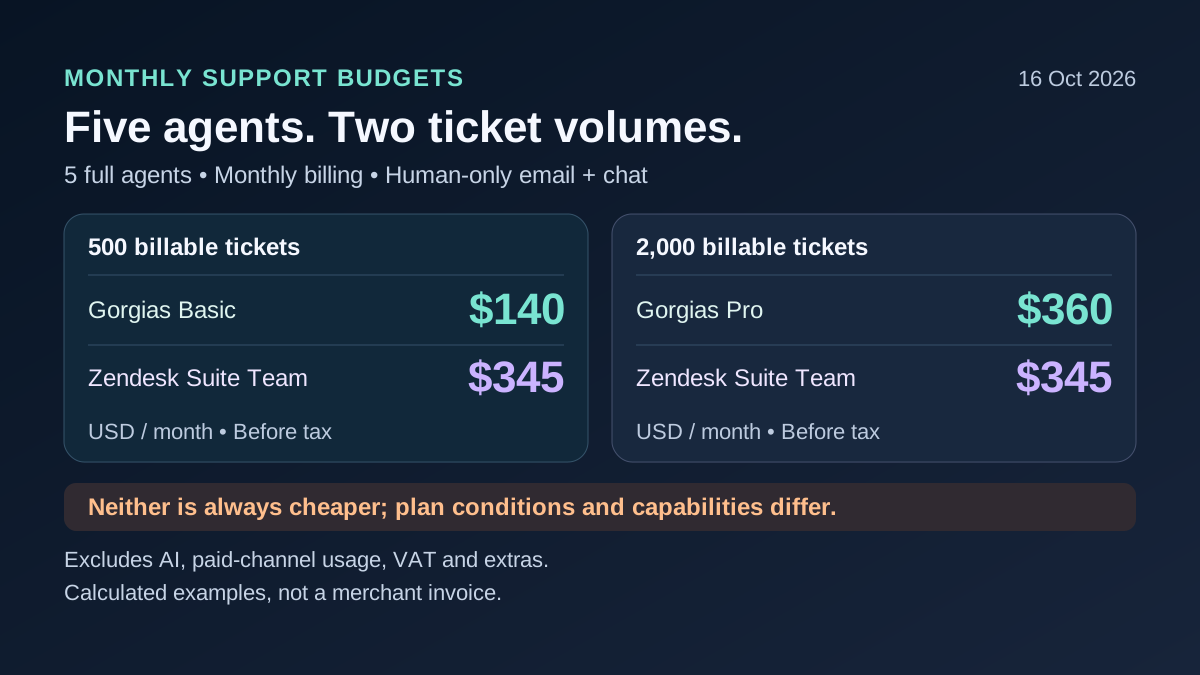
Assume one Shopify support operation with three or five full responding agents, a human-handled email/chat workload, and no AI usage, paid-channel usage, third-party app charges or taxes. The Gorgias count is billable tickets, not every incoming message. Zendesk figures use monthly-paid Suite seats, not cheaper annual equivalents or limited-access collaborators. This is a base-budget comparison, not proof of identical Shopify permissions or reporting capabilities.
For 500 billable tickets, Gorgias Basic costs $60 plus 200 extra tickets at $0.40, or $140. Zendesk Suite Team costs $207 for three agents or $345 for five. At 2,000 tickets, Gorgias Pro's $360 base is higher than those same Suite Team seat totals. Professional costs $447 or $745 for the corresponding teams. The apparent winner changes with volume and the required tier; 'ticket-based always saves money' and 'per-seat always costs more' are both misleading shortcuts.
For annual context, five Suite Team agents cost $3,300 upfront for a year, while five Professional agents cost $6,900. Gorgias Basic's annual base is $600 and Pro's $3,600, but annual payment does not establish unlimited tickets, monthly rollover or a freely spendable annual pool. Confirm allowance periods and transition terms before forecasting a promotion. The ecommerce software stack guide and SaaS spending guide help keep required versus optional costs separate.
| Billable tickets / full agents | Gorgias configuration | Gorgias total | Zendesk Suite Team | Zendesk Suite Professional |
|---|---|---|---|---|
| 500 / 3 | Basic: $60 + 200 × $0.40 | $140 | $207 | $447 |
| 500 / 5 | Basic: $60 + 200 × $0.40 | $140 | $345 | $745 |
| 2,000 / 3 | Pro: within 2,000-ticket allowance | $360 | $207 | $447 |
| 2,000 / 5 | Pro: within 2,000-ticket allowance | $360 | $345 | $745 |
What Counts as a Gorgias Ticket? Replies, Reopens and Merges
Gorgias's billing guide counts a Helpdesk ticket when at least one outgoing message is sent by a human, Rule or AI Agent. Several replies inside that ticket do not each create another Helpdesk ticket. Unanswered inbound spam does not meet that trigger, but an automatic acknowledgment can. Review the actual rule rather than assuming every automatic message is free because no employee clicked Send.
An incoming email more than ten days after the last message creates a new ticket; chat and the documented messaging channels use more than three days. The new ticket can become billable when the helpdesk replies. These rules apply regardless of open/closed status and are separate from AI's 72-hour human-involvement window. A delayed delivery complaint can therefore generate another billable ticket even when it concerns the same customer and original order.
Merging conversations does not universally erase charges. The guide's examples retain two billable Voice tickets after a merge, while a billable email merged with an unanswered email counts as one Helpdesk ticket. Do not extrapolate that example into a refund for every duplicate thread. Basic's overage is per actual excess ticket: 302 tickets cost $60.80, not a mandatory extra hundred-ticket purchase. If the issue is broader platform fit, the Zendesk alternatives guide offers other models to evaluate.
Gorgias AI Costs: An AI-Resolved Ticket Can Use Both Allowances
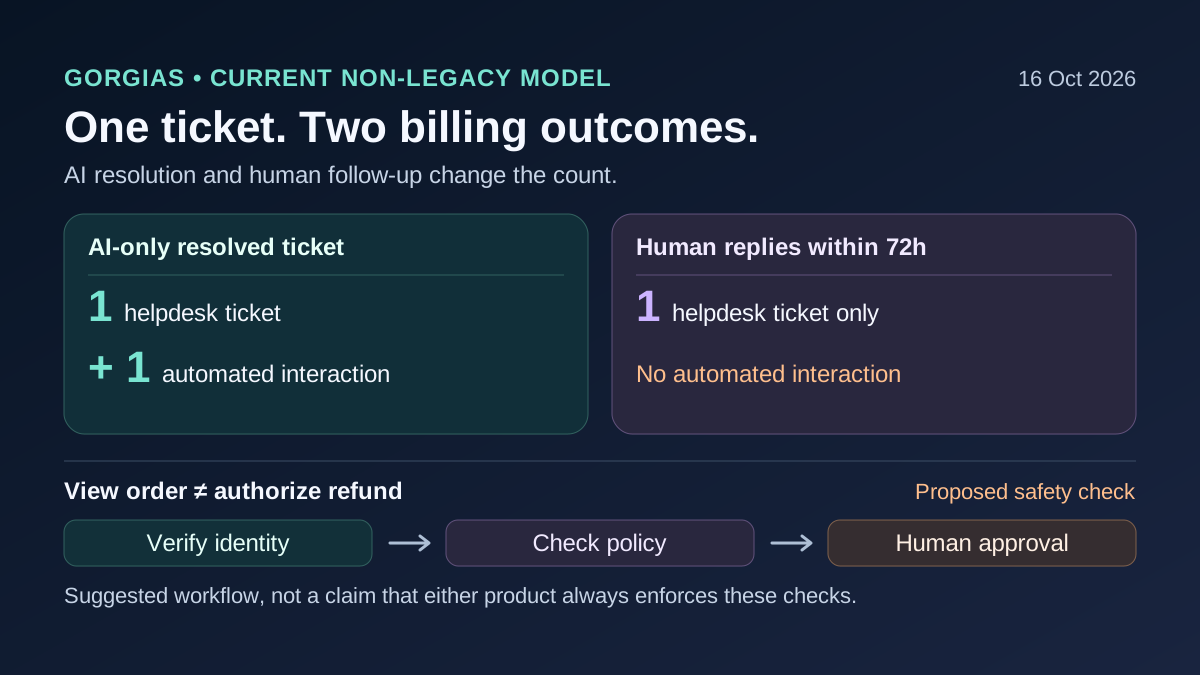
Under the current documented model, an AI-only resolution can consume one Helpdesk ticket and one automated interaction. Human involvement within 72 hours prevents the automated-interaction charge, not an already billable Helpdesk charge. Other self-service flows can have different event combinations. Eligible legacy accounts use an either/or model, so another merchant's older invoice is not proof of your account's terms.
Consider Basic on monthly billing with 500 total billable tickets, of which fifty are finalized AI-only resolutions, and the displayed thirty-interaction AI tier. Helpdesk is $60 plus $80 ticket overage. AI is $30 for the selected tier plus twenty excess interactions at $1.50, or another $30. Total: $200 before extras and tax. The Helpdesk count remains 500, not 450. This is a quote-specific example, not a claim that this commitment is the optimal configuration for every store.
The calculator quotes $1 per included-tier interaction on monthly billing and $0.90 annually, with $1.50 above the selected allowance. An Advanced comparison-grid figure of $0.85 conflicts with its displayed annual calculator arithmetic; do not generalize that lower rate. Finalized billing outcomes can also lag a closed-ticket dashboard. The AI customer-service guide provides broader context, but review correctness and later human escalation separately from a vendor's automation percentage.
| Charge component | Calculation | USD amount |
|---|---|---|
| Helpdesk base | 300 tickets included | $60 |
| Helpdesk excess | (500 - 300) × $0.40 | $80 |
| Selected AI tier | 30 interactions × $1 | $30 |
| AI excess | (50 - 30) × $1.50 | $30 |
| Total before extras and tax | $60 + $80 + $30 + $30 | $200 |
Zendesk AI Costs: Identify the Billing Generation First
Zendesk's resolution-tier documentation describes the model introduced May 18, 2026. Verified resolutions consume allowance after an LLM-based verification; Assisted escalation and Contained resolution do not. That billing classification is not an independent guarantee that an answer was correct. The documented conversation-end window is 72 hours after the first email, two hours after the first messaging message by default, and hangup for voice. Do not replace those with one universal inactivity timer.
For accounts on that model, the allowance guide gives Suite Team $2 per paid agent seat per month and Suite Professional $5. Five seats therefore contribute $10 or $25 monthly, not ten or twenty-five guaranteed resolutions. Light agents do not contribute, unused monthly allowance does not carry over, and the included allowance has a $5,000 annual maximum. Older automated-resolution guidance uses different count-based allocations. Confirm the account model instead of combining the most favorable parts of both.
Exact current per-resolution rates for the chosen Zendesk contract were not established, so a matching fifty-resolution AI invoice is not invented here. Overage is allowed by default on the documented allowance model; eligible accounts can select a pause instead, with separate Forethought restrictions. Copilot is another optional product, available on Professional and higher plans: at $50 per agent/month annually, five Suite Professional seats plus Copilot total $9,900 a year before usage. Do not add it automatically to make one side look expensive. Compare only the assistance and channels the team requires, using the support-platform comparison when broadening the shortlist.
Shopify Order Actions: Zendesk Is Not Read-Only
Gorgias's Shopify connection guide documents customer and order context, while its action guide covers refunds, cancellations, shipping-address changes and other edits. General editing excludes archived orders, orders older than sixty days and orders in another currency. Manual refunds also have payment-method limits. A supported refund action is not proof that every historical or mixed-payment order is eligible.
Zendesk's Shopify usage guide documents full/partial refunds with review and confirmation, and cancellation of unfulfilled orders in Support. An administrator enables those actions through the integration setup. Its text is inconsistent about fulfillment-state eligibility for particular partial refunds, so verify the intended order state. General shipping-address editing is not established by that guide; this is not a claim that no other app or API can provide it.
The useful scenario starts with 'Where is my order?' and becomes 'Cancel it and refund me.' First retrieve the correct storefront, customer, tracking and fulfillment context; then evaluate a money-changing action. Zendesk matches a saved ticket requester's email or phone, and unsaved tickets do not retrieve the same context. Multiple stores and matching identifiers do not prove brand isolation or identity. Our Shopify review and online-store platform guide help separate storefront requirements from helpdesk capabilities.
Refund Permissions and AI Handover Need Explicit Rules
Gorgias's permissions matrix distinguishes Observer, Lite, Basic, Lead and Admin roles. Lite can reply but cannot perform third-party order actions; Basic and higher can perform actions such as Shopify refunds. Basic here is a role, not the subscription named Basic. Connecting Shopify requires the documented administrative access, but neither vendor's reviewed integration guides establish that each subsequent action rechecks the operator's individual Shopify staff refund permission.
Gorgias's AI Shopify actions guide describes an eligible unfulfilled-order cancellation that refunds the full amount paid. That is not equivalent to giving an AI unrestricted discretionary refund authority. Shopify address changes or cancellations do not automatically propagate to a separate fulfillment provider, and address changes cannot determine every tax or shipping adjustment. Configure eligible actions, timing and policy; use human handover for disputed identity, suspected fraud and exceptions.
Evaluate with synthetic orders and authorized staff before any live money action. Check a permitted refund, a blocked request, a partially fulfilled order, the wrong storefront and a failed fulfillment-provider update. Confirm that escalation retains the customer's context and does not repeat an already completed action. The automation guide is useful for planning handoffs, but an integration or model response is not business approval to refund. No live order action was performed for this article.
Exports: Metadata, Messages and Attachment Files Are Different
The Gorgias export guide separates a View CSV with metadata and links from an analytics export with message content. The latter is limited to the most recent thirty days within the selected period and up to 100,000 tickets, and excludes internal notes, ticket events and specified social-message content. A one-million-row metadata allowance is not a one-million-conversation archive. Export permissions vary by route; verify the operator's actual entitlement rather than assuming every CSV is admin-only.
Zendesk's account-export guide excludes Team plans from its standard account-export tools, although authorized REST API exports are available across plans. Eligible account owners must request enablement. CSV omits descriptions and comments; JSON supports comments but omits them for tickets exceeding 1 MB, and the account-export guide excludes AI-agent tickets. A file labeled full export therefore still needs a coverage check, particularly when automated history is important to the store.
Zendesk's attachment guidance requires separate file retrieval rather than treating attachment references as downloaded binaries. Download links can expire and private attachments need authorized access. Gorgias's documented export link lasts fourteen days; Zendesk says at least three days for account-export links. Those are link lifetimes, not retention guarantees. Preserve necessary files and messages in approved storage before cancellation; the cloud-storage guide explains why access to a file is not automatically a complete backup process.
A Practical Selection and Cutover Checklist
Create normal and peak forecasts using the same full-agent count, required channels and actual billable-event definitions. Include reopened conversations and any AI commitment or overages. Voice, SMS and other usage can add charges beyond both base tables. Confirm the exact Zendesk Shopify messaging setup because newer setup documentation and older Chat instructions differ. Record unresolved pricing, trial and annual-allowance terms in the software evaluation checklist rather than filling gaps with assumptions.
Then rehearse the workflow and exit: retrieve the right order, reply, attempt an authorized action, hand over an exception and export a representative conversation with an internal note and file. Rebuild routing, macros, knowledge sources, roles and integrations deliberately; an imported ticket count is not evidence that these settings migrated. Keep the source available until identifiers, timestamps, customer history and independent file access have been reconciled. Avoid running duplicate outbound rules during cutover.
Choose Gorgias provisionally when Shopify order operations and the ticket-plus-AI model fit the business. Choose Zendesk provisionally when its selected suite and seat model support the required service process at an acceptable total cost. If either fails permissions or archive requirements, a lower headline price does not solve the problem. Alternatives such as Help Scout or Freshdesk deserve a separate requirements-led review. No platform choice guarantees faster support, fewer staff or better sales; those outcomes need an actual measured pilot.
Buyer checklist before you choose
Common mistakes to avoid
Helpful Softora links
Frequently asked questions
Which is cheaper for Shopify: Gorgias or Zendesk?
It depends on ticket volume, full responding agents, features and AI usage. The monthly example for 500 billable tickets is Gorgias Basic $140 versus Zendesk Suite Team $207 for three agents or $345 for five. At 2,000 tickets, Gorgias Pro is $360. These base figures exclude AI, paid-channel usage, taxes and extras; they do not establish equivalent features or a universal winner.
Does Gorgias's $10 plan include thirty free AI interactions?
That is not established by the checked calculator. Starter Helpdesk alone is $10; selecting the displayed thirty-interaction AI tier changes the total to $40, split into $10 Helpdesk and $30 AI. Marketing/schema wording differs, so verify the selected offer rather than treating an AI-inclusive bundle's allowance as free in every base subscription.
Does Gorgias charge for a ticket resolved only by AI?
Under the current documented model, an AI-only resolution can consume both one Helpdesk ticket and one automated interaction. Human involvement within 72 hours prevents the automation charge, not the Helpdesk charge. Eligible legacy subscriptions have different either/or terms; confirm the actual account model.
Can Zendesk refund or cancel Shopify orders?
Yes. Its documented Shopify integration for Support includes full/partial refund controls and cancellation of unfulfilled orders after an administrator enables the actions. Partial-refund eligibility has inconsistent fulfillment-state wording in the guide, so verify the required order scenario. The integration is not merely read-only order context.
Can every Gorgias agent issue Shopify refunds?
No. The current role matrix allows Lite users to reply but not perform third-party order actions; Basic, Lead and Admin roles can perform actions such as refunds. Basic is a role name, not the plan tier. The reviewed guides do not establish that every action rechecks the operator's individual Shopify staff refund permission.
How much AI allowance do five Zendesk agents receive?
For accounts on the newer resolution-allowance model, five paid Suite Team seats contribute $10 per month and five Suite Professional seats $25. These are currency pools, not guaranteed numbers of resolutions. Unused monthly amounts do not carry over; light agents do not contribute. Legacy count-based allocations and actual per-resolution contract rates need separate confirmation.
Does reopening or merging a Gorgias ticket avoid another charge?
Not automatically. A new incoming email more than ten days after the last message, or chat message after more than three days, can create another ticket that becomes billable when replied to. Merging preserves applicable channel charges; it does not universally remove duplicate billable events. These windows differ from the AI human-involvement window.
Can I export every conversation before switching helpdesks?
Check the exact route. Gorgias metadata CSVs omit message bodies, while its content export has date/row limits and excludes internal notes and specified social content. Zendesk's standard account exports exclude Team plans and AI-agent tickets; CSV omits comments, and JSON has a large-ticket comment limit. Authorized API and separate attachment retrieval may be needed. No complete migration is guaranteed by an export button.
Get practical software advice every week.
Join Softora readers who get SaaS buying guides, pricing changes, and comparison notes without the marketing noise.


