
Duda vs Webflow (2026): Agency Pricing, Client Handoff & Export
Compare Duda vs Webflow for agencies: current pricing, one-to-ten-site budgets, client billing, editing permissions, ownership transfers, and code export limits.

Key takeaways
Duda separates the account subscription from additional published sites. Webflow separates Workspace capabilities, worker seats, and each custom-domain Site plan; a paid Workspace is not mandatory for hosting.
Five sites illustrate $792/year on Duda Agency, $1,320 on Webflow Agency plus Basic sites, or $1,920 with Premium sites. These are different feature bundles, not measured savings.
Duda Client Billing can collect agency service charges through Stripe; Webflow Client payments lets clients pay Webflow for site-related costs. Neither automatically transfers ownership.
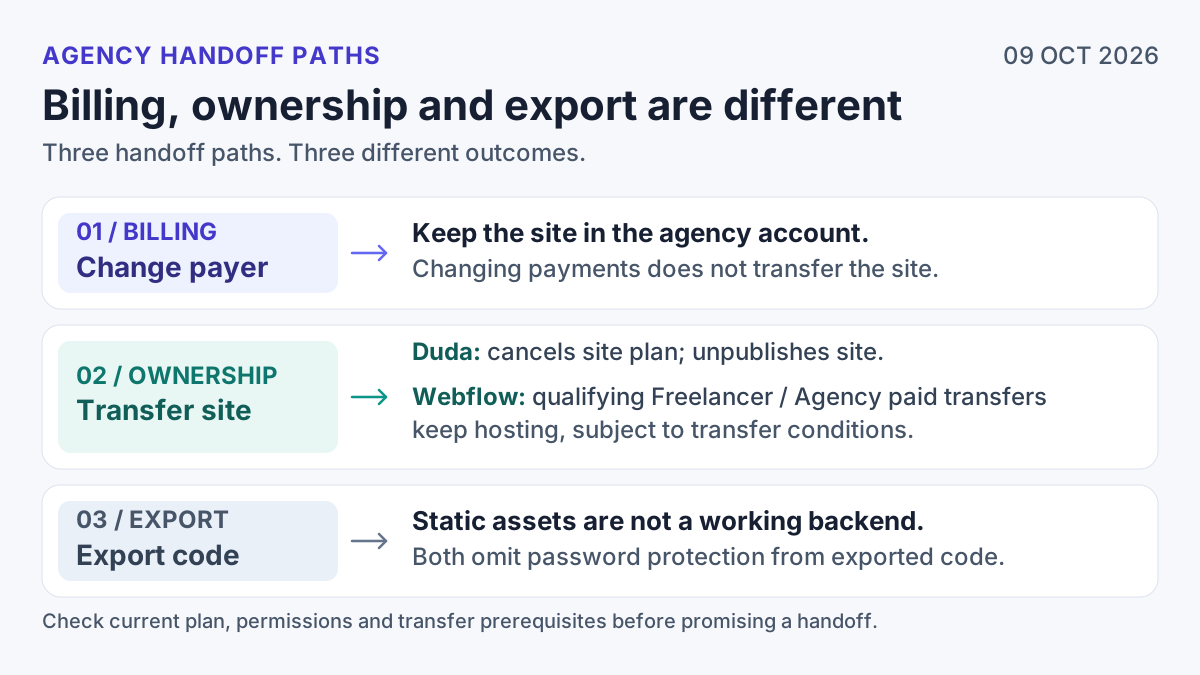
Duda site transfer cancels the site subscription and unpublishes the site. Webflow documents a continuity-preserving paid transfer from Freelancer/Agency, subject to prerequisites and usage limits.
Both code exports omit functioning backend services and password protection. A ZIP archive, data CSV, or platform ownership transfer is not a complete independent-hosting migration.
Duda vs Webflow: The Agency Decision in Brief
Duda versus Webflow is not just a contest between website editors. For an agency, the larger decision is how to sell, maintain, bill, and eventually hand over client websites. Shortlist Duda for a managed portfolio where its included sites, client permissions, and optional branded platform fit the service. Shortlist Webflow when its design and CMS workflow, client-owned Workspace route, or qualifying paid-site transfer better matches the contract. Neither choice automatically makes the finished site easier to maintain or more profitable.
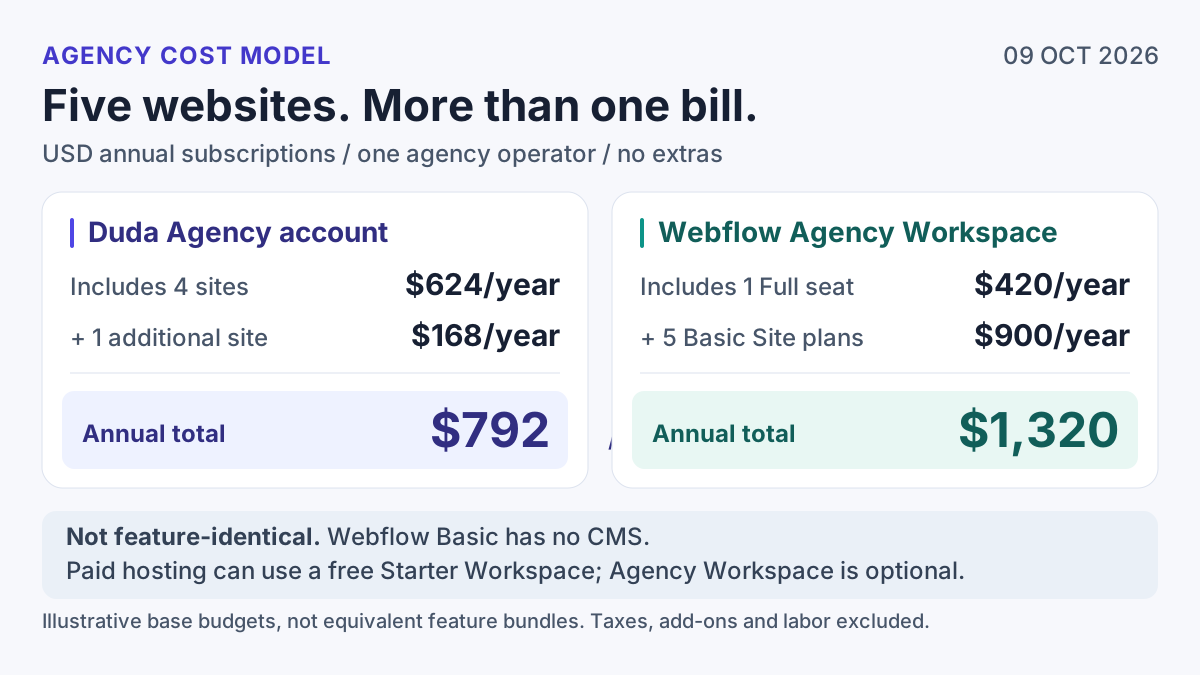
The clearest cost example is five websites managed by one operator. On annual subscriptions, Duda Agency plus a fifth standard site totals $792 a year. Webflow Agency Workspace plus five Basic Site plans totals $1,320; using five Premium Site plans makes that $1,920. Those are not identical feature bundles: Webflow Basic has no CMS, while a free Starter Workspace can host paid sites without the Agency subscription. A useful comparison must show that cheaper route instead of presenting a paid Workspace as unavoidable.
Methodology: this October 9, 2026 comparison uses AI-assisted documentary research and official pricing/help pages, not hands-on testing. No account was opened, client charged, website transferred, or performance benchmark run. Search suggestions and comparison coverage informed the questions, not volume or difficulty estimates. Dollar calculations use verified USD list prices and exclude taxes, promotions, domains, extras, and labor. The website-builder directory provides a wider shortlist; this guide focuses on the agency's operating agreement, including where official documents conflict.
Current Pricing: Account, Workspace and Site Plans
Duda's current pricing page separates the account from additional published sites. Its annual account equivalents are Basic $19, Team $29, Agency $52, and White Label $149 per month, charged upfront. Basic and Team include one published site; Agency and White Label include four. Additional standard Website Builder sites cost $19 monthly or $171 annually on Basic, and $17 monthly or $168 annually on the other three. These are not Duda Vibe prices. Exact month-to-month account amounts were not verified for this article and are not inferred from the annual figures.
Webflow's current pricing has a different split. Basic custom-domain hosting is $15 per site per month billed annually or $25 month-to-month; Premium is $25 or $39. Freelancer Workspace is $16 monthly equivalent on annual billing or $24 monthly, while Agency Workspace is $35 or $42. Each includes one Full owner seat. Under the Workspace and Site-plan overview, a paid Workspace is not mandatory for hosting: even Starter supports unlimited sites with paid Site plans. Staging quotas and live hosting are separate.
The current Site-plan guide uses Premium, although parts of the pricing comparison still show inconsistent Premier or CMS labels. Do not reuse an older CMS/Business grid as the current offer. Basic has no CMS; Premium lists 20,000 CMS items and 40 Collections. Duda's 14-day trial is temporary, whereas Webflow Starter can remain free on its subdomain with substantial limits. Our free small-business software guide explains why free evaluation, free staging, and a free production service are different promises.
| Subscription | Annual equivalent | Month-to-month | Included scope or boundary |
|---|---|---|---|
| Duda Basic account | $19/month | Not verified | One published standard site; extra standard sites $171/year or $19/month |
| Duda Team account | $29/month | Not verified | One published site, three team seats; extra standard sites $168/year or $17/month |
| Duda Agency account | $52/month | Not verified | Four published sites, six team seats; full platform white labeling not included |
| Duda White Label account | $149/month | Not verified | Four published sites, six team seats, agency-branded platform; extras still apply |
| Webflow Starter Workspace | $0 | $0 | One Full owner seat, unlimited paid sites; two free staging sites; hosting paid separately |
| Webflow Freelancer Workspace | $16/month | $24/month | One Full owner seat, ten staging sites, export and agency guest access; hosting separate |
| Webflow Agency Workspace | $35/month | $42/month | One Full owner seat, unlimited staging; additional worker seats and hosting separate |
| Webflow Basic Site plan | $15/site/month | $25/site/month | Custom-domain hosting; no CMS; 10 GB monthly bandwidth |
| Webflow Premium Site plan | $25/site/month | $39/site/month | 20,000 CMS items, 40 Collections, 50 GB monthly base bandwidth; expansion costs extra |
Portfolio Costs for One, Five and Ten Websites
The table below calculates annual subscriptions for one operator and one, five, or ten custom-domain sites. It deliberately includes Webflow's free Starter Workspace as well as paid alternatives. A Duda Agency account costs $624 annually, then $168 for each standard site beyond the four included. Webflow Agency is $420 annually, plus $180 for each Basic site or $300 for each base Premium site. Different site capabilities and client permissions remain relevant; these figures are budget arithmetic, not measured customer savings or a claim of identical service.
For five sites, Duda Team is $348 plus four additional $168 site subscriptions: $1,020. Agency is $792 because four sites are included. White Label is $1,788 plus $168: $1,956, a $1,164 annual premium over Agency at the same site count. Decide whether the branded client platform earns its place in the service before treating it as mandatory. The SaaS spending guide applies the same discipline: compare the required package and quantities, not whichever headline makes a preferred vendor look cheapest.
Webflow introduces another variable when staff join. Its seat-management documentation and pricing distinguish the included owner from additional seats. An extra Full seat is $39 per month billed annually or $45 monthly; a Limited seat is $15 or $19. Duda Team lists three team seats and Agency/White Label six. Do not extrapolate this one-person table to a six-designer shop without recalculating roles. Our agency project-management guide helps define who needs design access versus review access before buying seats.
A client-owned Webflow arrangement can split rather than remove the same costs. Five clients each paying $180 annually for Basic sites, plus the agency's one $192 Freelancer Workspace for guest access, totals $1,092 across everyone involved. The agency's direct bill is smaller than that combined figure, but the overall service has not become free. Include the client's subscriptions alongside the agency's overhead when preparing a transparent proposal. Domain renewals, templates, localization, commerce, optional bandwidth, and integration subscriptions remain outside every example shown here.
| Configuration | 1 site / year | 5 sites / year | 10 sites / year |
|---|---|---|---|
| Duda Team | $348 | $1,020 | $1,860 |
| Duda Agency | $624 | $792 | $1,632 |
| Duda White Label | $1,788 | $1,956 | $2,796 |
| Webflow Starter + Basic sites | $180 | $900 | $1,800 |
| Webflow Freelancer + Basic sites | $372 | $1,092 | $1,992 |
| Webflow Agency + Basic sites | $600 | $1,320 | $2,220 |
| Webflow Agency + Premium sites | $720 | $1,920 | $3,420 |
Client Billing Is Not Website Ownership
Duda's Client Billing documentation describes an agency collection workflow on Team and higher, using Stripe. The account owner administers billing; team members do not. Clients need a client login to pay but do not need a website assigned to that login. Requests can cover website work and other services, with one-time charges or recurring monthly/annual subscriptions. The site can therefore remain in the agency's account while the client pays the agency. That is a billing relationship, not an ownership transfer.
The Duda Client Billing product page says Duda adds no Client Billing fee; Stripe processing fees still apply and depend on the relevant country and arrangement. No universal Stripe rate or merchant-country eligibility is assumed here. A retainer, a platform subscription, and processing are different lines in the invoice. Pair the workflow with the freelancer invoicing guide if you also need bookkeeping or project invoicing. A successful payment request does not establish that tax handling or a whole accounting workflow is covered.
Webflow's Client payments guide instead lets Freelancer/Agency owners or admins have a client pay Webflow directly for the Site plan and associated bandwidth or add-ons, while the site stays in the agency Workspace. One paying client is associated with each site, and the client's account must not be a member of that agency Workspace. Do not describe this as a substitute for collecting your own agency retainer. Our marketing-agency software guide treats platform bills and service revenue separately for exactly this reason.
Client Editing: Permissions, Seats and Publishing Rights
Duda's Manage Clients guide assigns permissions per site. Widget content permits editing existing content, not deleting widgets or changing their design; Editor is broader and includes layout, widgets, pages, and settings. Site republish changes an already-live site, while Site publish also allows first publication, which can trigger a charge to the account owner. Unlimited client accounts do not mean every client should receive every permission. Test the actual role with View as Client, not only an administrator's view.
Webflow's client-seat guide distinguishes Content editor, component-based Marketer, and Reviewer roles. Starter includes one client seat per paid site; Freelancer one per staged or paid site; Agency three per staged or paid site. There is an official source conflict: pricing's detailed matrix displays one for Agency, while its card and dedicated guide say three. Confirm the account entitlement before contracting around it. Extra client seats cannot currently be purchased, and these seats are not a workaround for giving same-business-domain employees free paid-member access.
For client-owned sites, the agency/freelancer guest role offers a different arrangement. The client can retain a Starter Workspace; the visiting agency must have Freelancer or Agency. Authorized guests do not consume the client's paid seats and cannot manage the host's general, billing, or team settings. That is different from sharing the client's login. Record publisher, approver, and recovery contact in a system such as Notion, then check the live roles before treating the handoff as complete.
White Label, Reusable Design and CMS Requirements
Duda's current pricing explicitly reserves full platform white labeling for White Label and Custom. The editor, dashboard, previews, and platform emails can use the agency's branding and platform domain. Buying Agency alone does not grant that experience. Website branding, removing a vendor badge, and branding the administration platform are different requirements. No equivalent full-platform self-serve white-label entitlement was verified for Webflow. If the brand requirement is essential, obtain a precise entitlement rather than assuming a professional website plan automatically includes a reseller platform.
Duda Dynamic Pages start on Team; the guide identifies Agency for Google Sheets and Airtable connections and Custom for external databases through its API. A shared layout draws from collection records, but source-data access is a separate permission boundary and the collection needs its own backup. Dynamic Pages cannot be password-protected or membership pages. A public directory and a restricted portal are different jobs; the Softr review is another comparison route when controlled app-user access is central.
Webflow Premium's CMS allowance may suit a structured publishing project, but its records are not directly equivalent to Duda pages or collection rows. Ask how the team creates a record, validates required fields, updates a shared component, reviews the result, and publishes it. Webflow Agency advertises unlimited Shared Libraries; that is not unlimited hosting. The content marketing stack guide helps define that editorial process, while Webflow versus Framer is useful if the real decision is a single design-led marketing site rather than an agency portfolio.
Bandwidth, SEO and AI Visibility: Avoid Outcome Promises
The pricing pages expose different traffic models. Duda advertises unlimited website bandwidth and storage; Webflow Basic includes 10 GB monthly and Premium starts at 50 GB, with paid additions available. Do not confuse Premium's advertised expansion up to 2.5 TB with its included base allowance. Model the site the client will actually run: a video-heavy portfolio, large images, downloadable files, and embedded services have different delivery costs. The hosting and DevOps directory helps distinguish the website subscription from other infrastructure the project might still require.
Duda's SEO settings guide documents titles, descriptions, a site-wide noindex switch, and generated sitemap/robots files, with some controls differing between standard editors and Vibe. Webflow's current Site-plan documentation also describes SEO and publishing features. These are implementation capabilities, not evidence that one platform will rank a particular client higher. Use our small-business SEO guide to plan useful content and technical checks, and preserve existing URLs or deliberate redirects during a rebuild.
Google's AI-features guidance explicitly says no special AI text files or schema are required for AI Overviews or AI Mode. Meeting its requirements does not guarantee crawling, indexing, or serving. A builder's AI-visibility add-on therefore cannot honestly become a promise of Google inclusion. Measure the finished site's actual behavior and search data instead of borrowing a vendor-wide performance score. An audit with Sitebulb or Screaming Frog can flag technical issues, but neither a clean crawl nor a schema field proves improved rankings.
Transferring a Duda Site: Plan for Unpublishing
Duda's site-transfer guide is important to read before offering a seamless client exit. The receiving account needs an active subscription, its owner must accept the transfer, and the link expires after 24 hours. After transfer, the existing site subscription is canceled and the site is unpublished. The recipient must select and pay for a site subscription, then republish. A transferred design is therefore not a promise that the original paid hosting subscription continues unchanged or without interruption.
The same guide blocks transfer for sites with current add-on subscriptions, unpaid invoices, Site-for-Life status, or Client Billing setup. It does not establish that merely canceling a Stripe charge removes the Client Billing restriction. Resolve the site's actual state before scheduling the move. Store plans are also canceled during transfer, although order history and configured settings are retained; some features can disconnect. Custom widgets require the same widget in the destination account, and contact-form responses may not transfer. A handoff checklist must account for these records and dependencies separately.
Put a maintenance window, receiving owner, new subscriptions, integrations, and rollback responsibility into the agreement. Keep the plan practical for a client who may never have used Duda before. Moving the entire account is a different process governed by Duda's account-transfer terms, not the site-transfer button. The consultant software guide offers a useful contract-and-delivery context, and the Duda review covers its broader platform boundaries. A canceled subscription alone does not prove refund eligibility for unused time.
Transferring a Webflow Site: Continuity Has Conditions
Webflow's Client payments documentation supports a paid-site transfer from Freelancer or Agency into the client's Workspace without downgrading the Site plan or taking the site offline. That is a materially different documented path from Duda's unpublishing step, but it is not a claim that every transfer from every Workspace tier behaves that way. The recipient needs to accept and complete the supported flow. If billing already uses Client payments, that arrangement continues; when the agency paid, unused subscription value is handled as Workspace credit, not a promised cash refund.
Usage can block the expected transition. After two consecutive months over applicable bandwidth, Analyze, or Optimize limits, the client must select and pay for a sufficient plan or add-on before the transfer completes. Installed Libraries also become site-local components, assets, and variables rather than retaining the original shared-library connection. These are acceptance checks, not minor administrative details. A client's launch promise depends on capacity, design dependencies, billing, and ownership all being ready, even when the transfer feature is documented as preserving hosting continuity.
The agency loses editing access after transfer unless invited back, so arrange post-handoff support explicitly. A client-owned Workspace with authorized agency guest access can avoid a later ownership move if that is the preferred relationship from the outset. Our freelancer tools guide and software evaluation framework help distinguish a finished deliverable from an ongoing service. Do not leave both sides assuming the other owns renewals, urgent edits, or a failed contact form after the final design invoice is paid.
Code Export: What Does Not Travel to Another Host
An internal ownership transfer keeps the website on its existing platform. Export is a different exit. Duda's Site Export guide allows Agency and higher to export a published site up to 1 GB. The archive contains web assets, not the Duda editor or a complete operating backend. Stores, Dynamic Pages, membership and app data are excluded; blog content is supplied as RSS rather than blog-page HTML. Contact forms and personalization stop working. Putting the archive on another host does not rebuild those services.
Webflow's code-export guide requires a paid Workspace; buying only a paid Site plan is insufficient. HTML, CSS, JavaScript, and assets can be downloaded, and an exported static site does not need a continuing Webflow subscription merely to run. CMS functionality/content, the ecommerce database and checkout, site search, and Webflow form processing are not portable in that archive. Collection and product records can have separate CSV exports, but data files are not a replacement CMS or a functioning store.
Both guides identify the same consequential security boundary: password protection does not survive code export. Never put a restricted page's exported contents on public hosting without removing the material or implementing proper authorization first. Files that were safe behind the source platform's access control can become ordinary public assets at the destination. The Vultr review and Hetzner review illustrate why independently hosting the output brings operational responsibilities; a server rental does not automatically restore either builder's authentication or application services.
Retain authorized copies of content, form submissions, products, uploads, redirects, and integration configuration before cancellation, and validate what the receiving system actually imports. Do not promise that a ZIP or CSV is a one-click WordPress migration. Our WordPress.com review covers a managed product, not every self-hosted WordPress setup; the Shopify review addresses a separate commerce decision. The export matrix below is a scope checklist. No website export, restore, or cross-platform migration was performed for this article.
| Item | Duda export | Webflow export | Destination work |
|---|---|---|---|
| Eligibility | Agency+; published site up to 1 GB | Paid Workspace; paid Site plan alone insufficient | Confirm account permission and representative export scope |
| Layout and assets | Published HTML, CSS, JavaScript and media; no transferable builder | HTML, CSS, JavaScript and assets; no hosted editor/backend | Verify responsive rendering and licensed asset use |
| CMS and blog | Dynamic Pages omitted; blog supplied as RSS, not blog-page HTML | CMS content/functionality omitted from code; separate data export | Rebuild publishing, templates, records, navigation and URLs |
| Store | Store omitted; product CSV is separate | Ecommerce database and checkout do not travel | Migrate authorized records and implement selling services separately |
| Forms and search | Contact forms and dynamic behavior stop working | Webflow form processing, upload services and site search do not travel | Implement replacements and verify actual submissions and results |
| Password protection | Protected pages export without their protection | Site/page password protection omitted | Remove restricted material or implement proper authorization before publishing |
| Apps and integrations | App/membership data omitted; some widgets stop working | Integrations and backend behavior need separate assessment | Inventory dependencies, access, data copies and renewal obligations |
What Belongs in the Agency's Real Operating Budget
Price the complete delivery agreement: platform subscriptions, employee seats, site capacity, domain renewals, email, paid components, selling features, third-party services, and maintenance time. Duda commerce/booking subscriptions and Webflow commerce or optional add-ons are not included in the brochure-site examples. A higher software bill may still fit a valuable service, while a lower one can hide work nobody budgeted. The complete small-business SaaS stack helps expose those dependencies instead of treating the website builder as every tool the client needs.
Record the account's actual renewal and cancellation rules as well as the client's payment schedule. Duda's site-subscription guide distinguishes disabling site auto-renew, which unpublishes at cycle end, from immediate cancellation without a refund for unused time. Client Billing subscriptions also need their separate Stripe lifecycle. Do not assume ending an agency retainer cancels the underlying platform, or that canceling a platform plan cancels every connected service. A written subscription inventory is more useful than a vague promise to handle everything.
For a hypothetical fixed-price website, state which services the fee covers and which the client buys directly, including work needed at exit. A short recorded handoff through a tool such as Loom can explain roles and renewals, but it does not replace access checks or transfer acceptance. Use the invoicing and accounting category for the financial system around the service. Keep customer payments, supplier costs, refundable amounts, and vendor credits distinct; a credit in an agency account is not money already returned to its client.
A Pilot That Tests the Contract, Not Just the Homepage
Prepare one representative project using synthetic or expressly approved client material. Include a service page, a long mobile page, a contact form, a reusable section, and a collection record if CMS is required. Evaluate the chosen paid tier's entitlements rather than relying on trial-only access. Have the person who will maintain the site change a price, replace an image, and request publication. Record where they need help. This is a proposed buying test, not an assertion that Duda or Webflow has already passed it for your team.
Then exercise the permission boundary with a content editor, reviewer, and publisher—not only the owner. Check whether an edit affects other pages, whether the client can expose an unfinished page, and who can create a new subscription charge. Follow one authorized form submission into the intended CRM or inbox and test a controlled failure. The no-code automation guide helps map those integrations, while the website launch checklist context keeps the test tied to the visitor's actual next step.
Finally, rehearse the agreed exit on a non-production sample where feasible, or obtain written confirmation of unsupported prerequisites before making a client promise. Check destination ownership, subscriptions, ongoing agency access, records, forms, and restricted content. Avoid rehearsing an irreversible transfer on a live client's only site. The Webflow alternatives guide can widen the shortlist if a mandatory requirement fails. A larger plan or an appealing template does not resolve a contractual need for an exportable backend, isolated client permissions, or a particular ownership model.
Final Decision: Three Agency Models, Different Answers
For a local-business agency maintaining several standardized sites, Duda Agency is worth evaluating: four included sites and its account-level collaboration can fit a managed-service portfolio. White Label is a separate commercial decision, not the automatic next step. Its value depends on whether your clients need a branded administration platform and whether the service can support its premium. Keep the documented transfer interruption and Client Billing restrictions in the agreement rather than discovering them when a client asks to leave.
For a design-led studio or a client that expects to own its Workspace, Webflow's design/CMS workflow, guest access, Client payments, and qualifying paid-site transfer may fit better. Choose Basic only for sites without CMS requirements and budget Premium where necessary. Starter Workspace remains a valid low-overhead hosting route; Freelancer or Agency should earn their cost through the staging, access, export, or collaboration features actually required. Framer or Squarespace may deserve a separate trial if neither agency operating model matches the brief.
For a contract demanding a fully self-hosted, editable handover with functioning forms, CMS, commerce, and restricted content, neither code-export button alone satisfies the requirement. Price the rebuild or choose an architecture designed for that ownership model. The defensible Duda-versus-Webflow choice comes from the same written requirements, dated invoice assumptions, permission checks, and exit evidence—not an unsupported universal winner. Use the software evaluation checklist to document why the chosen platform fits this client and what it does not include.
Buyer checklist before you choose
Common mistakes to avoid
Helpful Softora links
Frequently asked questions
Is Duda or Webflow better for an agency?
Duda is worth evaluating for an agency-managed portfolio with included sites, client capabilities, and optional full platform white labeling. Webflow can fit a design/CMS workflow or client-owned Workspace arrangement with agency guest access. Neither is universally better. Compare the actual site and seat budget, publishing roles, client payment model, and eventual handoff requirements rather than a general editor score.
How much do five client websites cost on Duda and Webflow?
For one operator on annual subscriptions, five standard Duda sites cost $1,020 on Team, $792 on Agency, or $1,956 on White Label. Five Webflow Basic sites cost $900 with a free Starter Workspace, $1,092 with Freelancer, or $1,320 with Agency. Agency plus five Premium sites is $1,920. These are USD base calculations before extras and tax, not feature-identical packages: Basic has no CMS and staffing allowances differ.
Do I need a paid Webflow Workspace to host client websites?
No. Starter Workspace supports unlimited sites carrying their own paid Site plans and includes one Full owner seat, although free staging is limited. A paid Workspace buys other capabilities such as expanded staging, code export, guest access, Client payments, and collaboration controls. Custom-domain hosting still requires a Site plan for each website. Buying Agency does not pay for every site's hosting.
Does Duda Agency include full white labeling?
No. Full platform branding is documented for White Label and Custom, not Agency. Agency and White Label both include four published sites, while their annual account prices are $624 and $1,788 respectively, a $1,164 difference. Confirm whether the contract requires a branded editor, dashboard, platform domain and emails, or merely a finished website without a vendor badge.
How many client seats does Webflow Agency include?
The dedicated client-seat guide and Agency pricing card say three per staged or paid site. A detailed pricing row says one, so official sources conflict and the account allowance should be confirmed. Starter lists one per paid site and Freelancer one per staged or paid site. Additional client seats cannot currently be purchased; clients are not interchangeable with paid employee or design/admin seats.
Can a client pay without owning the website?
Yes. Duda Client Billing on Team+ can collect agency charges through Stripe while the site remains in the agency account; payment does not require assigning editing access to a site. Webflow Client payments on Freelancer/Agency can make the client pay Webflow for Site plans and related add-ons while the agency retains the site. Neither billing change automatically transfers platform ownership, and the two billing products cover different charges.
What happens when an agency transfers a paid client site?
Duda's guide says the site subscription is canceled and the site unpublished; the receiving owner must arrange a subscription and republish. Client Billing setup and other restrictions can block transfer. Webflow documents an active-plan transfer from Freelancer/Agency without downgrading or downtime, subject to prerequisites and usage-related upgrades. Agency access, libraries, credits, integrations, and the next payer still require checks. A canceled charge or Workspace credit is not automatically a cash refund.
Can Duda or Webflow export a complete website for self-hosting?
Neither code export should be treated as a complete functioning builder/backend migration. Duda Agency+ exports published web assets within its size limit, while Webflow requires a paid Workspace. CMS/dynamic content, stores, forms and other hosted services have exclusions or need separate data handling. Both omit password protection, so restricted material must be removed or protected at the destination before publication. An internal ownership transfer is a different operation from independent hosting.
Get practical software advice every week.
Join Softora readers who get SaaS buying guides, pricing changes, and comparison notes without the marketing noise.


