Flodesk vs Kit (2026): Pricing, Free Plans & Automation
Compare Flodesk vs Kit (ConvertKit) on current free plans, costs at 1,000-10,000 subscribers, automation, selling fees, and migration risks for creators.

Key takeaways
Kit Free supports broadcasts to up to 10,000 subscribers, but current documentation puts sequences and Visual Automations on paid plans. Recommendations can be disabled.
Flodesk Free collects subscribers without sending campaigns. New paid plans scale with subscribers; legacy unlimited pricing and temporary workflow/checkout bonuses are different offers.
At 5,000 subscribers, Flodesk Pro is $59 monthly versus Kit Creator $89. Those tiers fit a paid-automation comparison, not a claim that all features are equivalent.
Both tools have visual templates and conditional automation. Evaluate actual click, branch, buyer-exclusion, and repeat-entry behavior instead of relying on old product stereotypes.
Country eligibility, payment fees, and recurring subscriptions require separate checks. A CSV migration does not move an operating workflow or prove payment continuity.
The Short Answer: Free Publishing or a Paid Creator Workflow?
Choose Kit, formerly ConvertKit, first if you need to publish a newsletter without a subscription fee: its current Free plan supports broadcasts to up to 10,000 subscribers. Shortlist Flodesk Pro if you need paid email workflows and its design tools fit the person producing your campaigns; its monthly subscription is lower than Kit Creator at the three matched list sizes below. Neither statement makes one platform universally better. Commerce eligibility, the way buyers leave sales sequences, and the cost of rebuilding an existing setup can change the decision.
The old shorthand of beautiful emails versus powerful automation is incomplete. Flodesk now documents conditional branches, click actions, and buyer exclusions. Kit supports visual email templates, not just plain text. More importantly, some older comparisons describe a free Kit automation or mandatory recommendations; the current Free-plan guide says automation is paid and recommendations can be disabled. This article compares the documented offer for a new decision, not an assumed entitlement on every legacy account.
Research method: AI-assisted research and writing based on official pricing, help articles, and product documentation checked October 7, 2026. Calculations and evaluation procedures are identified as such; no hands-on deliverability, conversion, support-speed, or migration benchmark was performed. The cover is an illustrative workspace photograph, not a product screenshot. Use the individual Flodesk review and Kit / ConvertKit review for broader product context, and the email marketing category if your shortlist is not yet limited to these two.
Free Plans: Collecting Subscribers Is Not Sending a Newsletter
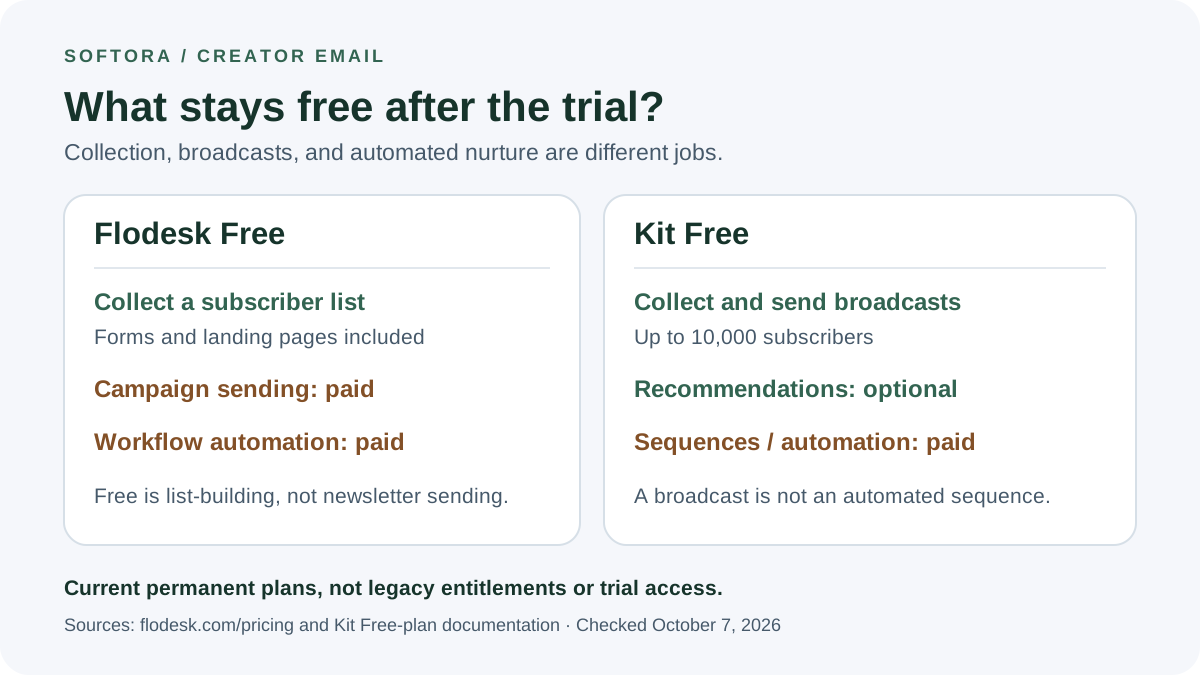
According to Kit's current Free-plan specification, Free includes up to 10,000 subscribers, unlimited broadcasts, forms and landing pages, tagging, segmentation, digital products, and API access. It does not include email sequences, Visual Automations, Rules, or RSS campaigns. A scheduled broadcast to an audience and a sequence that starts separately for each new subscriber are different capabilities. If an automated welcome series is essential, budget for Creator rather than planning around an older one-free-automation allowance.
The same guide makes the recommendation rules explicit. Free accounts start enrolled in the Creator Network, with five automatically populated Smart Recommendation slots that the creator can edit. Recommendations can be switched off without losing other Free-plan features. Paid accounts receive priority in recommendations, and earning from Paid Recommendations requires a paid plan. Discovery is a possible benefit, not guaranteed subscriber acquisition. Check an existing account's billing and entitlements separately if it still carries the older Newsletter name.
Flodesk's pricing FAQ distinguishes its continuing Free plan from a paid-feature trial. Free supplies forms, landing pages, and list-building tools, but neither campaign sending nor workflow automation. A successful test during the trial does not prove that sending continues when the trial ends. A creator who only wants to collect interest before launching can use that boundary deliberately; someone publishing every Friday needs a sending plan. Our free small-business software guide provides the wider context, but compare the actual free job rather than a Start free button.
| Capability | Flodesk Free | Kit Free |
|---|---|---|
| Audience collection | Forms and landing pages; no active-subscriber limit advertised | Forms and landing pages; up to 10,000 subscribers |
| Newsletter broadcasts | Not included | Unlimited broadcasts within the subscriber allowance |
| Sequences and visual automation | Not included | Not included under the current Free-plan guide |
| Recommendations | No comparable Creator Network entitlement assessed here | Five editable Smart Recommendation slots; recommendations can be disabled |
| Native product sales | No active Checkout selling on Free | Available, subject to country eligibility and transaction fees |
| Downgrade from paid to Free, once effective | Sending and workflows stop; forms can continue collecting | Built automations and sequences remain stored but stop running |
Pricing at 1,000, 5,000, and 10,000 Subscribers
The table uses current Flodesk pricing and Kit pricing, with the same billable subscriber count and month-to-month billing throughout. These are USD subscription prices before taxes, processing fees, and outside tools. Flodesk Lite is the sending entry point; Pro adds unlimited workflows and a second seat; Everything adds expanded commerce and a third seat. Kit Creator supplies core paid automation and two total users, while Pro adds capabilities such as advanced reporting and unlimited team members. Similar price positions do not mean identical feature bundles.
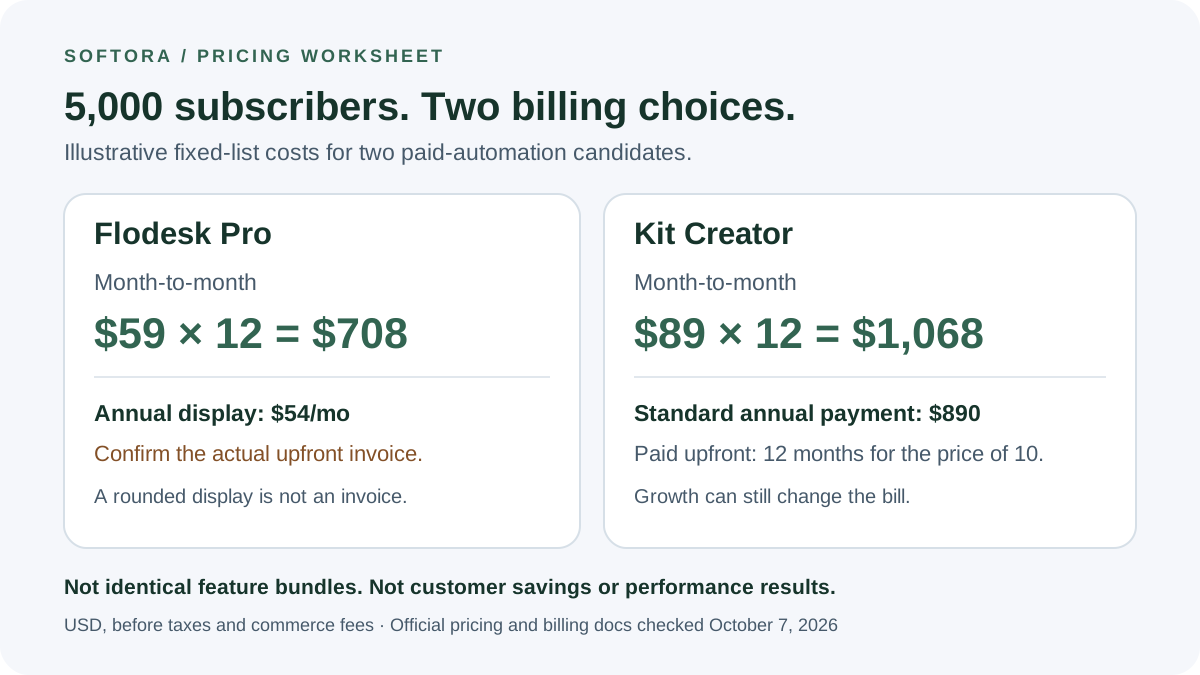
For a 5,000-subscriber business needing several automated journeys, compare Flodesk Pro at $59 monthly with Kit Creator at $89, not Flodesk Lite against Kit Pro. The difference is $30 each month, or a calculated $360 across twelve unchanged monthly payments. That saving matters only if the cheaper option supports the actual journey, integrations, and operator. At 10,000 subscribers the same pair is $79 versus $139 monthly, a $60 difference; a newsletter-only publisher fitting Kit Free could instead pay no base subscription at all.
Flodesk advertises Lite's single workflow and Pro's single checkout as limited-time bonuses. Do not treat bonus wording as an unconditional permanent entitlement. Its newer Products experience also uses different limits, explained below. If several workflows are non-negotiable, Pro's stated unlimited-workflow feature is the clearer budget basis. Compare against MailerLite or the Mailchimp alternatives guide when neither paid offer fits, but recalculate the same audience and features rather than carrying old starting prices into the decision.
| Subscribers | Flodesk Lite | Flodesk Pro | Flodesk Everything | Kit Creator | Kit Pro |
|---|---|---|---|---|---|
| 1,000 | $25/mo | $28/mo | $54/mo | $39/mo | $79/mo |
| 5,000 | $52/mo | $59/mo | $107/mo | $89/mo | $139/mo |
| 10,000 | $72/mo | $79/mo | $137/mo | $139/mo | $189/mo |
Annual Billing: Separate the Display, Invoice, and Growth Charges
Kit's billing guide states that standard annual billing gives twelve months for the price of ten. Creator therefore costs $390 upfront at 1,000 subscribers, $890 at 5,000, and $1,390 at 10,000. The entry annual-equivalent display rounds to $33 per month; multiplying that label by twelve would give $396, not the actual $390 annual amount. Kit Pro also has a time-limited first-year annual promotion on the checked pricing page. Keep any promotional invoice and its standard renewal price separate rather than comparing a temporary discount with another product's continuing rate.
Flodesk's annual selector displays Lite/Pro/Everything at $19/$25/$49 per month for 1,000 subscribers, $48/$54/$99 for 5,000, and $66/$72/$126 for 10,000. Those are displayed equivalents, not annual invoices verified in this research. Its FAQ's one-month-free wording and worked savings example do not reconcile cleanly with every rounded display. Use the checkout's actual upfront total before deciding; this guide does not manufacture a precise annual saving from those conflicting cues. The illustration below deliberately compares twelve monthly payments and labels the different annual evidence.
Annual payment does not freeze audience growth. Flodesk's subscriber-billing rules apply monthly-plan upgrades at the next billing date; annual plans are reviewed monthly and can incur prorated increases. Annual subscriber-tier decreases wait until renewal. Kit also upgrades paid tiers automatically, with its billing guide describing prorated adjustments on the next monthly invoice or immediately for annual plans. A lower Kit subscriber count requires requesting the eligible lower tier in billing settings; it is not an automatic price decrease. Record both timing and growth exposure in the SaaS spending checklist, and confirm account-specific refunds rather than assuming unused annual time is refundable.
What Counts as a Subscriber: Cold Is Not the Same as Unsubscribed
Flodesk's detailed billing definition counts Active and Soft Bounced contacts. Unconfirmed, unsubscribed, hard-bounced, spam-reported, cleaned, archived, and deleted contacts do not count. Active describes subscription status, not recent reading behavior. Moving an unengaged reader into a segment does not itself stop the billing. The same contact in multiple segments is not multiple separate subscribers, so adding segment sizes is not a reliable way to reconstruct the invoice.
Kit's subscriber-status reference counts Confirmed subscribers, including the Cold subset. Unconfirmed, unsubscribed, complained, blocked, and hard-bounced profiles do not count; a confirmed subscriber with a temporary soft bounce still can. Someone can be valuable, inactive in tracking, and billable at the same time. For a useful forecast, record total stored contacts, marketable contacts, paying customers, and the vendor's actual billable number as separate figures.
List cleaning is not simply deleting everyone without a tracked open. Readers may still buy, reply, or read with tracking limited, and paying subscribers can have billing relationships attached to their record. Establish a documented re-engagement and consent process, inspect purchases, and preserve necessary suppression evidence. Our email pricing mistakes guide explains why the charging unit matters; the recurring-payment warning below is why a cheaper subscriber count must not be pursued by blindly deleting customers.
Email Design: Test a Real Campaign, Not a Product Stereotype
Flodesk's visual layouts, templates, and branding controls make it a reasonable shortlist for a design-led service or creator business. That is a workflow hypothesis, not evidence of higher conversion. Build a representative campaign with a long headline, a useful explanation, a product image, one primary action, and readable fallback text. Inspect it on a narrow screen and with remote images unavailable. A polished gallery example does not prove your actual message remains understandable under those conditions.
Kit's visual template editor supports reusable sections and visual styling, with custom CSS available. It also supports a separate custom-HTML template route. The important constraint is that visual templates do not expose editable HTML, and custom-HTML templates cannot be edited through the visual template editor. Decide who maintains the template before handing it to a designer or assistant; a technically editable template can still be the wrong operating choice for a nontechnical owner.
Use the same content brief in both candidates and record whether the future operator can make routine changes without breaking mobile readability or opt-out links. Keep the image-heavy material accessible with meaningful text, not an entire email flattened into a graphic. The creator tools guide and Canva alternatives guide cover adjacent production choices, but neither a design app nor an attractive template removes the need to inspect the delivered email.
Automation: Both Have Branches, but Their Behavior Matters
Flodesk is not limited to a straight line of emails. Its Yes/No branch documentation covers workflow-email opens, link clicks, segments, and custom-field conditions. Click and open branches include a time window: a qualifying action can send someone down Yes before the window ends; otherwise they take No after expiry. An action arriving too late does not retroactively reroute them. Newly added branches rejoin the main path unless an explicit Exit stops them, while older unchanged branches can retain legacy behavior.
Its Multiple branch guide documents up to twelve data/segment branches plus Everyone else, and up to six percentage branches for experiments. Data branches are checked left to right, with the first matching branch winning. Link Actions can add or remove segments and workflows or set a custom field after a click, including in standalone campaigns. They do not run in preview test emails, and security-scanner clicks can trigger them. A condition checked at one point, an event-driven click action, and random experimental assignment are different mechanisms.
Kit Creator and Pro include Visual Automations and sequences. Its conditions reference supports tags, custom fields, advanced filters, and email opens; its events guide describes events that pull someone forward when, for example, a purchase or tag change occurs. That forward movement can end a sales sequence without waiting for the next ordinary step. Match the desired timing and data, not just whether both canvases have a diamond-shaped condition. For workflows spanning other apps, the no-code automation guide provides the wider design discipline.
Two Creator Workflows to Evaluate Before Buying
First, model a photographer's enquiry journey: a visitor requests a planning checklist, confirms where required, receives the resource, and gets relevant follow-up. Use a new address, an existing subscriber, an unconfirmed signup, and someone repeating the request. Flodesk's trigger rules allow multiple entry branches, but repeat enrollment must be enabled with a wait period and only happens after the prior run finishes. Do not assume a second signup restarts an in-progress workflow. In either tool, record which event delivers the resource and whether welcome content repeats unnecessarily.
Second, model a course promotion: an interested subscriber enters a sales sequence, buys before the next sales message, receives onboarding, and can leave promotions without necessarily leaving every newsletter. Flodesk's workflow exclusions can prevent entry and remove someone mid-run when they join an excluded buyer segment. Simply removing them from the original trigger segment does not do that. Kit documents purchase events that remove buyers from a sales sequence. In both cases, the purchase must actually reach the correct product or buyer field.
These are proposed acceptance tests, not tests performed for this article. Verify the next scheduled promotion does not send after the purchase is recognized, that a delayed integration does not silently lose the buyer event, and that a promotional opt-out leaves only the communications the person still wants. Use only authorized evaluation accounts; follow each vendor's payment-testing procedure rather than making an accidental real charge. The software evaluation framework turns those outcomes into a documented decision instead of choosing by the number of automation features advertised.
Selling Products: Check Country, Plan, and Fees Separately
Flodesk's Products plan guide describes a staged rollout distinct from older Checkout screens. Pro can publish unlimited one-time products but one sales page at a time; Everything adds unlimited sales pages, subscriptions, and payment plans. Lite can draft products but not publish them. Even a zero-dollar product requires an enabled Stripe connection to publish. Existing checkouts are not automatically converted, so confirm which commerce experience your account has before treating product count, sales-page count, and checkout count as interchangeable.
Eligibility comes before a fee comparison. Flodesk Checkout's country guide lists specified legal business locations, including the US, UK, Canada, Australia, New Zealand, and a named set of European countries, with territory restrictions. Kit's commerce guide has its own supported-country list, which is not identical to the list in Kit's terms. If the documents disagree for your jurisdiction, obtain confirmation before building a sales operation. Pakistan is not listed in either product's reviewed operational country list. That limits native selling, not necessarily use of the email-marketing service.
Kit's currency-specific fee table lists USD transactions at 3.5% plus $0.30, including card processing rather than adding that fee on top of a second standard Stripe charge. A calculated $50 sale therefore incurs $2.05, leaving $47.95 before taxes, refunds, subscription software, and other costs. One hundred identical sales produce $205 in those stated transaction fees, not a universal 3.5% deduction without a fixed component. GBP uses 3.5% plus £0.20 and EUR 3.5% plus €0.25. A Kit product has one configured currency; changing it requires creating another product rather than editing the original currency.
Flodesk's pricing FAQ says it adds no transaction surcharge on top of Stripe processing. That is not zero-cost payment collection: the applicable processor rate and additional services still need checking. This research did not verify a Flodesk processor quote for every country or payment method, so it does not invent a universal 3% rate or a precise two-platform break-even point. Model subscription cost, percentage charges, per-order charges, and extras separately. For inventory, shipping, and a fuller store operation, compare Shopify or WooCommerce through the ecommerce software guide instead of assuming a creator checkout replaces the whole store.
Paid Newsletters: A Subscriber Export Does Not Move Recurring Billing
Kit's payment setup creates a separate Kit-managed Stripe Express account for native commerce, even if you already use Stripe. Connecting an existing Stripe account through an integration is a different arrangement. A CSV containing paying customers' email addresses does not establish that their payment method, renewal schedule, and authorization have moved to another platform. Confirm the supported transfer process with the vendors before cancelling any existing service.
The Kit subscription lifecycle contains an important operational warning: a customer unsubscribing from your email list stops future native subscription charges, and deleting that subscriber has the same consequence. Deleting a subscription product or closing the Kit account also cancels its active subscription billing. Do not unsubscribe paying members from the entire mailing list or delete their records as a casual clean-up shortcut. A topic-specific preference, leaving a sales sequence, cancelling a product subscription, and leaving the whole list must be treated as different actions.
If subscription revenue is your main product, write down what should happen to billing and access after each action, then verify it before launch or migration. Keep the original payment setup until the replacement can maintain the required authorized billing and access. Our Substack review and Beehiiv review cover other newsletter-oriented models, but they are alternatives to investigate, not evidence that recurring customers transfer automatically between any two platforms.
Growth, Reporting, and Team Access: Buy the Feature You Need
Kit's Creator Network adds a discovery channel alongside your own forms and campaigns. Recommendations, paid recommendation earnings, and a referral-reward program are not the same feature. The current Free plan permits editable or disabled recommendations; paid plans unlock earning from Paid Recommendations. The Creator-versus-Pro guide places the newsletter referral system, subscriber scoring, expanded analytics, and collaborative broadcast editing on Pro. Do not buy Pro merely to obtain the ordinary sequences already included in Creator.
Team access can decide the tier before list growth does. Kit Free supports one user, Creator two total users, and Pro unlimited team members. Flodesk's advertised Lite/Pro/Everything allocations are one, two, and three seats respectively. Two users means the owner plus one other person, not two assistants on top. A publication with a writer, editor, and operations assistant should price their real access and review permissions instead of sharing the owner's password to force an unsuitable plan.
Reporting should answer a business question: which acquisition source brings confirmed readers, which campaign produces relevant replies, and which offer results in completed purchases or retained subscribers? A vendor's advanced deliverability report is not an independent inbox-placement benchmark, and a larger list is not automatically more revenue. Connect email outcomes to the content marketing workflow and choose suitable measurement using our analytics alternatives guide, without confusing an attractive dashboard with a demonstrated business result.
Forms and Integrations: Follow the Actual Subscriber Event
A platform listed in an integration directory does not describe every event it supports. Identify whether the connection creates a subscriber, adds a buyer label, updates an existing record, or imports historical purchases. Also check synchronization timing and what happens after a refund, duplicate event, or permission change. For a site built with Squarespace, WordPress, or another website builder, test the actual form or commerce path you use; a store-customer integration is not automatically a newsletter-block integration.
Kit's API overview makes API access available on every plan, including Free; individual paid apps and paid automation features remain separate. If you connect either tool through Zapier or Make, include the connector's task allowance, retry behavior, and permissions in the operating budget. The automation platform comparison helps choose that extra dependency, but it does not verify that a particular purchase event maps correctly to a subscriber in this setup.
Consent must survive the handoff. Flodesk's double-opt-in guide says forms default to enabled confirmation for new members joining after April 2, 2026, with form-specific settings and account-wide confirmation content. Existing active subscribers do not receive a new confirmation email on every form signup. Test both new and existing records, inspect who remains unconfirmed, and keep marketing permission distinct from purchasing a product. If a separate intake form is needed, the Typeform alternatives guide covers candidates, not a shortcut around either vendor's consent rules.
Deliverability: Neither a Design Style nor a Provider Guarantees the Inbox
This comparison does not establish that Kit or Flodesk has better inbox placement. Provider acceptance, receiving-server delivery, and final mailbox placement are separate stages, as our transactional-email delivery guide explains. A text-heavy design is not proof of delivery, and a visual template is not proof of spam placement. Sender authentication, recipient expectations, suppression handling, message content, and the destination mailbox remain relevant on both platforms.
Follow Google's email-sender requirements for the traffic you actually send, including authentication and applicable bulk-sender unsubscribe requirements. During an authorized pilot, inspect delivery failures, complaints, useful replies, completed confirmations, and purchases rather than choosing a winner from open rate alone. Flodesk specifically warns that security bots can activate Link Actions, so a tracked click should not automatically become irreversible evidence of a person's commercial intent. A tool change cannot repair a purchased list or a consent process that was never valid.
Migration Checklist: Preserve Permission, Rebuild Logic, Verify Billing
Start with the original records, not a simplified upload. Flodesk's CSV export can include active, unsubscribed, bounced, and spam-marked contacts from a segment; its download link expires after 24 hours. Kit's export includes status, tags, attribution, and custom fields, with links expiring after five days. Select the intended statuses and all results, not just the visible page. Retain a secure original export and keep a separate authorized-send subset so a migration cannot quietly reactivate an opted-out person.
For Flodesk-to-Kit, the official migration guide explicitly separates importing subscribers from recreating forms, templates, and workflows. For Kit-to-Flodesk, Flodesk's import guide recommends separate tag/segment CSVs and field mapping, and excludes unsubscribed, hard-bounced, and spam-complaint contacts from the sending upload. Preserve their suppression evidence separately rather than relabelling them as active. A record's arrival in the destination is not evidence that its old sequence position or billing state survived.
Migrate an authorized sample first. Reconcile counts and fields, keep import tags from triggering live journeys accidentally, and decide whether in-progress subscribers finish in the old platform or resume at a deliberately mapped point. Give each form, campaign, and renewal one active owner during cutover to avoid duplicate sends or charges. Keep the source until required history, files, and payment continuity are verified. Flodesk cancellation eventually stops sending and deactivates checkouts while forms can remain collecting; a scheduled annual cancellation can still face growth charges before term end. The SaaS evaluation checklist should therefore include exit criteria as well as launch criteria.
| Data or behavior | What to do | Evidence before cutover |
|---|---|---|
| Addresses and consent | Export full records securely; separate authorized recipients from suppressed contacts | Opted-out and unconfirmed records cannot receive an accidental campaign |
| Tags, segments, and fields | Map labels and data types; preserve a copy of the original export | Representative contacts have the intended fields and memberships |
| Forms and templates | Rebuild and replace embeds or links; inspect the delivered layout | A real source form reaches the correct destination and confirmation path |
| Workflow logic | Rebuild entries, branches, exclusions, exits, and integration events | Buyer recognition stops the next promotional send |
| In-progress sequences | Choose source completion or a deliberate destination starting point | No repeated welcome series, missed promised message, or double enrollment |
| Recurring payments | Confirm a vendor-supported plan separately from contact import | Authorized renewal and access continue without duplicate charging |
| History and source retirement | Retain required records and verify cancellation effects before closure | No required file, suppression record, or billing dependency remains unaccounted for |
Which Should You Choose? Three Decisions, Not One Universal Winner
For a new writer sending a manual weekly newsletter to up to 10,000 subscribers, evaluate Kit Free first. It has a real sending allowance, editable or disabled recommendations, and native commerce subject to eligibility and fees. Accept its branding, single-user boundary, and lack of automated sequences, or budget for Creator when the business needs them. Flodesk Free is a different choice for list collection before paid sending, not an equivalent free newsletter operation.
For a design-led business needing several workflows, compare Flodesk Pro against Kit Creator with the same audience. Flodesk has the lower base monthly bill in the 1,000-, 5,000-, and 10,000-subscriber examples, while both need a realistic branch, purchase, and consent test. Prefer the one the operator can maintain and that receives the events your workflow depends on. Keep an existing legacy Flodesk plan in a separate calculation; leaving it can sacrifice terms unavailable to a new customer.
For a paid publication, course business, or collaborative team, check commerce country, recurring-billing behavior, reporting, and seats before choosing the cheaper headline. Kit Pro's team and analytical features or Flodesk Everything's commerce features can matter, but neither is required simply because the list is growing. If neither passes the acceptance checks, broaden the email software shortlist or use our creator-email alternatives guide. The useful result is a documented plan, a tested subscriber journey, and an understood exit—not a promise that switching tools automatically produces more clicks or sales.
Buyer checklist before you choose
Common mistakes to avoid
Helpful Softora links
Frequently asked questions
Is Flodesk or Kit better for a new creator?
Kit Free is a stronger zero-subscription starting point for manual newsletter publishing within 10,000 subscribers. Flodesk Pro is worth evaluating for a paid design-led workflow and has a lower monthly base bill than Kit Creator at the three list sizes compared here. Choose using actual templates, buyer events, consent handling, seats, and commerce needs—not an assumed universal conversion advantage.
Is Kit the same platform as ConvertKit?
Yes. Kit is the current name of the platform formerly called ConvertKit. The older name still appears in searches and existing review URLs. Current plan entitlements and prices should come from Kit's present documentation, not a historical ConvertKit screenshot or an assumption that every legacy account has the same offer.
Does Kit still include a free email automation?
The current Free-plan guide checked October 7, 2026 places email sequences, Visual Automations, Rules, and RSS campaigns on paid plans. Free includes broadcasts to up to 10,000 subscribers. Older Newsletter-plan descriptions may differ; verify an existing account's actual entitlements rather than treating that older allowance as a promise for a new account.
Can I turn off recommendations on Kit Free?
Yes. Current official guidance says Free accounts can edit all five Smart Recommendation slots or switch Recommendations off without losing other Free-plan features. Paid accounts receive priority in recommendations, and earning from Paid Recommendations needs a paid plan. None of these features guarantees that another creator will send you subscribers.
Is Flodesk still unlimited at one flat price?
Not for a new subscriber-based plan. The old unlimited-subscriber offer closed to new members on December 2, 2025, while eligible continuing legacy accounts can retain different terms. New paid plans include unlimited email sends but scale with billable subscribers. The permanent Free plan collects a list without campaign sending, and Lite has a 25,000-subscriber ceiling.
What do Flodesk and Kit cost for 5,000 subscribers?
The checked month-to-month USD prices are Flodesk Lite $52, Pro $59, and Everything $107; Kit Creator $89 and Pro $139. For several automated journeys, Pro versus Creator is a useful starting comparison, not identical feature parity. Kit Creator's standard annual payment is $890. Flodesk's annual display shows Pro at $54 per month; confirm the actual upfront invoice instead of deriving it from that rounded label. Taxes and commerce costs are separate.
Does Flodesk have conditional automation and click triggers?
Yes. Its documentation covers Yes/No conditions, multiple branches, and Link Actions that can update segments, workflows, or a custom field. Newly added branches rejoin the main path unless an Exit stops them. A timed click condition and an event-driven Link Action behave differently, and Link Actions do not run in preview test emails. Validate the specific workflow rather than relying on an old no-automation comparison.
Can I move my email list and paid subscribers without rebuilding?
Subscriber exports can move selected records, but forms, templates, workflow logic, in-progress sequence positions, and recurring billing need separate planning. Preserve opt-out and consent evidence, test an authorized sample, and confirm payment continuity with the vendors before closing the source. Kit's native subscription guidance says a paying subscriber unsubscribing from your entire mailing list, or you deleting their record, stops future subscription charges; an email-address CSV does not transfer that payment arrangement.
Get practical software advice every week.
Join Softora readers who get SaaS buying guides, pricing changes, and comparison notes without the marketing noise.